
 1.Fill in the online form
 2.Review your Will
 3.Make Payment
 4.Sign your Will
It is not obligatory by law to prepare a Will for yourself and it is an easy task to put off. However, many problems can arise if you die without leaving a valid Will.
On this page:
- Deciding who inherits
- Inheritance Tax
- Appointing Legal Guardians for your children
- Setting up Trusts for children
- Charity Donations
- Funeral Arrangements
- Problems for those left behind
- Laws of Intestacy
Deciding who Inherits
If you do not have a Will the government will decide who inherits your possessions, property and money. Who inherits your estate will be decided by the Law of Intestacy (1925) and as you can imagine they are unlikely to divide your assets in the way you would choose. Under the Law of Intestacy if you are unmarried and have no close relatives your Estate will automatically pass to the Crown (government) if there is no valid Will in place.
By making a Will you can decide exactly who gets which assets and how much. This could be almost anything from personal belongings to pets or property. You will also help avoid unnecessary arguments amongst family members or relatives, that can arise when a deceased person's wishes are unclear.
Inheritance Tax
Inheritance tax is the tax you pay on your estate. In simple terms this is everything that you own at the time of your death, once you have taken away anything that you owe.
Writing a Will allows you to greatly reduce the amount of inheritance tax you pay or even eliminate it altogether. Certain things can be given to particular people and organisations without inheritance tax being charged on them. This then allows you to provide more money for the people you want to receive it rather than paying it to the taxman.
Further information on how Inheritance Tax works can be found on our page Inheritance Tax.
Appointing legal guardians for your children
If you have children who are below the legal age to live alone, preparing a Will is especially important. In your Will you can appoint guardians to care for your children in the event of your death. If you fail to do so the authorities will do so on your behalf, in the way they see fit. However, they may not choose the people you would have chosen to care for your children. This can be distressing for the children, as well as other family members, at a particularly difficult time. In some situations, this could mean that a partner (who you are not married to) is not granted guardianship, even though they are the natural parent.
Most people choose to appoint a family member as a guardian for their children, especially if the children are very young. With older children who have not yet reached eighteen, friends who live close by and share a similar lifestyle to your family are often appointed as guardians. It is recommended to appoint two guardians in your Will, who are partners and live together, as this will provide your children with a settled family environment at a very difficult time. If circumstances change then the guardians can be omitted from the Will and new guardians can be appointed, by means of writing a codicil. Alternatively, substitute guardians in case of a sudden change of circumstances can be appointed in the Will.
A guardian appointed in the Will would be responsible for the day-to-day care and upbringing of the child or children. How you would like your children to be brought up can be explained in a letter to the trustees to ensure your wishes are taken into account and made clear to the guardians chosen. The financial arrangements in relation to bringing up the children are best left to the trustees of your estate. They are also responsible for ensuring that any inheritance the children receive before they reach eighteen is held in a trust for them, until they are old enough to decide responsibly how to use it.
Further information on appointing legal guardians can be found in our section Do you need to appoint Legal Guardians?
Setting up Trusts for children
It is a good idea to set up a trust for your children's inheritance as it allows you some control over your money once you pass away. It is possible for you to lay down certain terms to help protect assets from youthful irresponsibility.
This is particularly useful when making long term financial provisions for disabled children.
For more information, see the section on Trusts.
Charity donations
In your Will you can include any legacy that you wish to leave to particular organisations or charities. This could be a specific amount of money or even a valuable item, for example a piece of jewellery.
Any charitable donations you make in your Will are free from Inheritance Tax.
Funeral Arrangements
By making a Will, you can ensure that the desired recipients of your assets gain access to them far more quickly than if there is no Will in place. This means that they can use any money you have set aside for funeral costs or inheritance you have left them to pay for the funeral arrangements, without having to use their own money.
Within your Will you can make known your wishes for your funeral, for example, whether you want to be buried or cremated, where you want the funeral to take place, and any specific hymns or readings you would like included.
Problems for those left behind
By not preparing a Will you inevitably would cause difficulties for those you leave behind, at a time which is already distressing.
Firstly, your next of kin may be unsure as to whether or not you have prepared a Will. This means that they would probably have to spend time and money on searching for one.
Once sure that no Will had been made they would probably go through the courts in an attempt to gain the power to deal with your estate. If a Will had been prepared this would be unnecessary as they would simply apply for probate, a process that is far quicker and easier to complete.
Due to the delay in gaining access to your assets, your next of kin would have to pay for funeral expenses from their own funds. There is also the possibility that they would have to pay inheritance tax before receiving any of your assets, a problem which often leads to financial hardship and even debt.
If you have children and their mother is not alive, unless you have appointed guardians, your next of kin would need to deal with this too. This is also dealt with through the court, which is costly and time consuming.
When your next of kin reached the point where they had access to your estate, they would have to distribute according to the Laws of Intestacy.
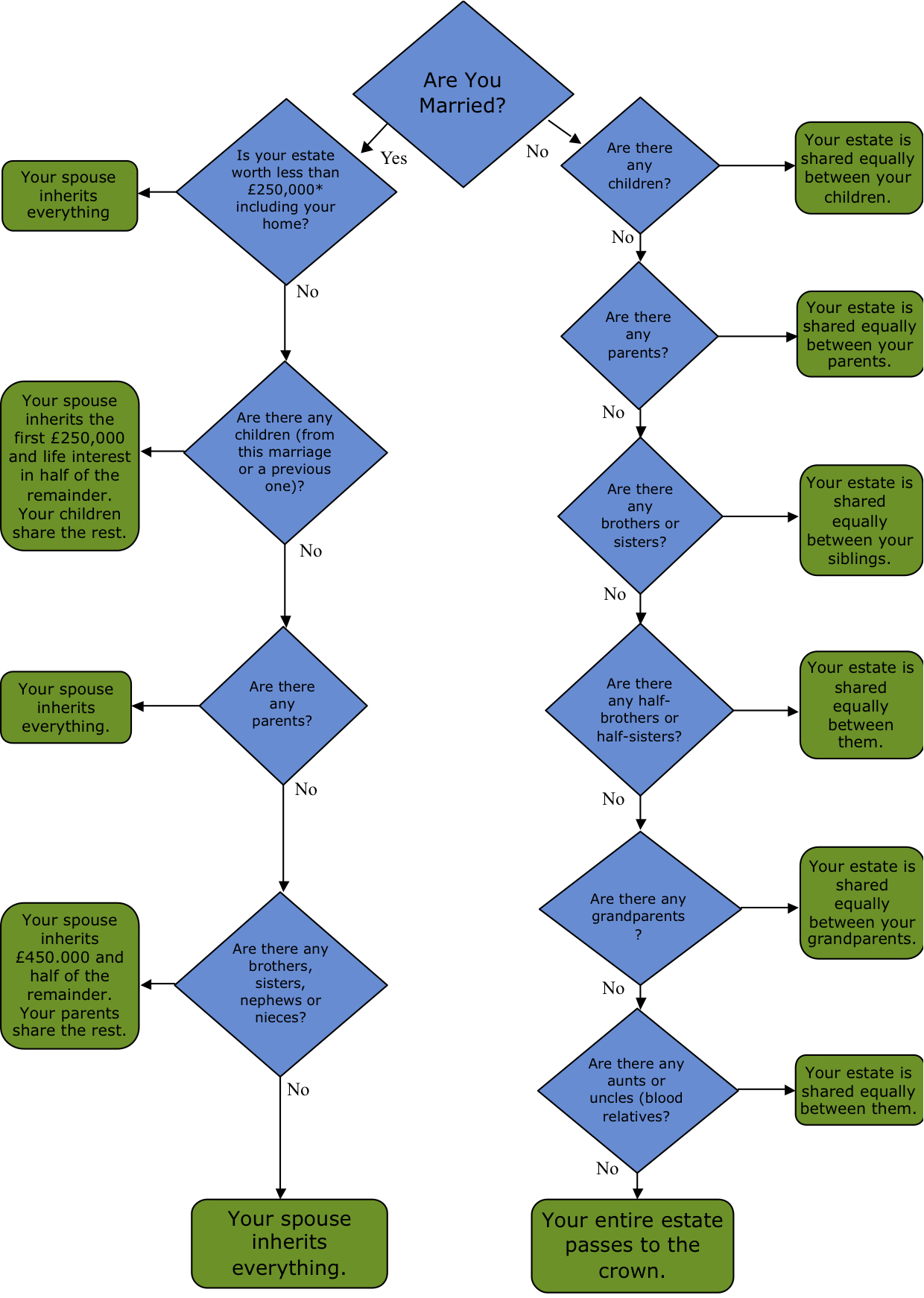
Laws of intestacy (England and Wales)
If you died leaving no valid Will, your estate would be distributed in accordance with the laws of intestacy. The flowchart below illustrates who would inherit your estate if you died without leaving a Will.